New patient information
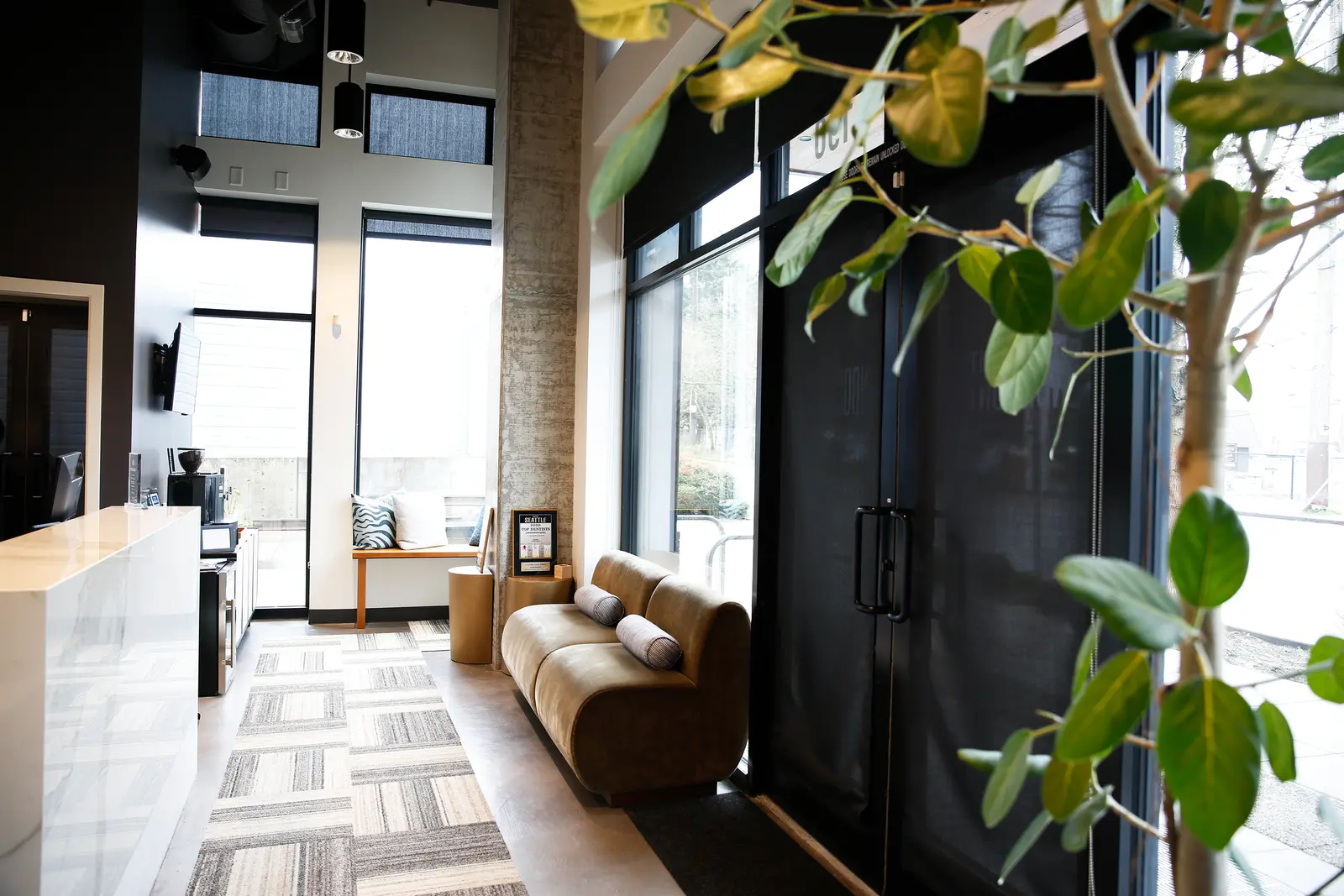
Your comfort is important. When you come in, you’ll be greeted with a smile and made to feel right at home, in a spacious reception room featuring work from local artists.
How your care starts
Your doctor will review your referral form (if you were referred by your general dentist) and your health history. Digital X-rays are then taken; these use significantly less radiation than traditional film X-rays.
CBCT and 3D imaging
Many cases also call for a CBCT scan: a focused three-dimensional X-ray of the tooth and the bone around it. A standard two-dimensional X-ray flattens everything into a single image, so roots overlap and small problems hide behind them. A 3D scan separates them.
That is how we count the canals in a tooth before we start, find a canal that was missed in a previous root canal, identify a crack or a root fracture, measure how close a root sits to a nerve or a sinus, and tell healing bone from a spreading infection. It changes the plan often enough that we would rather look than guess.
We scan only the few teeth in question rather than your whole head, so the dose is a small fraction of a medical CT scan and on the order of a conventional panoramic dental X-ray. If your doctor recommends one, they will show you on the screen what they are looking at.
Next, your treatment options are explained in simple, easy-to-understand terms, and our team presents you with a written estimate that includes your insurance benefits.
Innovative technology, less chair time
We use today’s state-of-the-art endodontic advances: the Global Surgical™ microscope, CBCT 3D imaging, electronic apex locators, virtually silent handpieces, diamond-coated ultrasonic equipment, and nickel-titanium files. Our experienced assistants use the surgical microscope alongside the doctor to anticipate what’s needed, which means more efficient treatment and less time in the chair.
The Biolase WaterLase laser
The whole point of a root canal is disinfection, and the limit on traditional technique is physics: irrigating solution does not flow readily into lateral canals or down into the apical third, the deepest part of the root and the place where most failures start. The laser drives energy through that solution, creating cavitation bubbles and much stronger fluid currents that push disinfectant into spaces a file or a syringe cannot reach.
We are Washington State’s leading Biolase provider, and laser-assisted disinfection is part of our routine treatment rather than an upcharge. More on laser endodontics →
Ozone
Where it fits, we add ozone as a supportive adjunct to standard chemical and mechanical disinfection. Ozone has documented antimicrobial activity and may help lower the microbial load in the treatment area. It does not replace conventional technique, and we will tell you plainly where the evidence is still developing. More on ozone therapy →
Collaborating with your general dentist
The best endodontic care is collaborative. Your general dentist receives a written report once your procedure is complete, and our doctors make themselves available to discuss your case whenever needed.
Before your visit
For the best experience we recommend a consultation before treatment. It’s a short visit, and it lets us go over four things that patients consistently tell us they wish they’d known first: how long treatment will take, the sequence of visits, what you can eat beforehand and whether you’ll be able to drive afterward, and what your insurance will contribute.
That last point can matter more than people expect. Under some plans, insurance pays less if you have treatment on the same day as your evaluation. Our goal is simple: help you pay less, and get the most your plan will contribute. A consultation is often how we do that.
If you’re in pain, none of this should stop you from calling. Emergency patients may receive treatment on the first visit when the evaluation confirms it.
Not every tooth needs a root canal
At least one in five patients we see leaves without a recommendation for root canal therapy. Our job is to work out what is actually wrong, and the answer is often something more conservative. Cracked tooth syndrome sometimes settles once the tooth is protected with a crown. A deep cavity may be restorable without entering the pulp. Some teeth only need to be watched and re-checked.
And some teeth are past saving, in which case we will say so plainly rather than treat a tooth that cannot be kept. We would rather tell you something inconvenient than do a procedure you did not need. See conditions we treat.
What we do to make you comfortable
The consultation is where comfort gets planned, and it works best if you tell us what you are actually worried about. The things patients mention that make the biggest difference:
- A strong gag reflex. Positioning changes, topical agents, and sedation all help, but they have to be planned before the day of treatment.
- Claustrophobia, or trouble lying back. We can adjust the chair, change how the drape and the rubber dam are placed, and build in breaks.
- Difficulty sitting still for a long appointment. This is a good reason to plan sedation, or to split one long visit into two shorter ones.
- Severe anxiety. Some patients do best with medication started before the appointment, occasionally a day or more ahead. That has to be prescribed in advance.
- A service animal. Welcome here. Tell us when you schedule so we can set the room up for it.
Where it is medically indicated we may also prescribe something to take before you come in — an anti-inflammatory, or in specific situations an antibiotic — and arrange nitrous oxide, oral sedation, or IV sedation with our partner anesthesiologist. None of that can be arranged at the last minute, which is the practical reason the consultation comes first. Sedation options →
Insurance, and why we would rather talk it through
We accept all insurance plans. We have deliberately not published a list of carriers, because the carrier’s name tells you very little: the same insurer sells plans with very different annual maximums, waiting periods, frequency limits, and endodontic percentages. Even the most generous plans we see still leave a copayment.
So call us with your plan information and we will go through it with you. We will do everything possible to advocate with your insurer so that your out-of-pocket cost is as low as it can be and your plan contributes the most it will. Then you get a written estimate before anything is scheduled. Insurance and payment details →
Bringing children
We treat children, and we are glad to. We do ask that you not bring children who are not being treated. There is nothing for them to do in the waiting room, no one free to watch them, and the treatment area is not a safe place for a child to wander. If childcare is the obstacle, tell us when you schedule and we will find a time that works.
What to bring
- A photo ID — your insurer requires one before we can bill your plan
- Your insurance card, and your FSA or HSA card if you have one
- A list of current medications
- Any X-rays or notes from your referring dentist, if they weren’t sent ahead
- A driver, if you’ll be having oral or IV sedation
Parking
The garage uses Metropolis. You can pre-register your plate in the Metropolis app or at app.metropolis.io before you arrive, and the gate will read it automatically. The first hour is free. Full directions are on our location page.