Biolase laser endodontics
The primary goal of every root canal is disinfection. Adding the Biolase laser lets us disinfect more deeply and more predictably than chemical and mechanical techniques alone.
Why laser-assisted irrigation matters
Traditional root canal disinfection works through chemical irrigation and mechanical cleaning. The laser advances this with enhanced fluid dynamics and cavitation bubbles that reach into lateral canals, and it can specifically target the apical third: the deepest part of the root canal, and the place where most traditional failures occur.
We are Washington State’s leading Biolase provider, and laser-assisted disinfection is integrated into our everyday treatment rather than reserved as an add-on.
Why we chose this technology
There is more than one way to improve on syringe irrigation, and we looked closely at the alternatives before committing. Four things decided it.
It works on any tooth we can reach
Some advanced irrigation systems have to build a sealed platform on top of the tooth before they can run. That rules out teeth which can’t be sealed: open root ends, roots sitting against the sinus, teeth with resorption or a perforation, and teeth without enough structure left above the gum. Those are exactly the cases a general dentist sends to a specialist. We didn’t want a disinfection method we would have to set aside on the hard ones. The laser needs access to the canal and nothing else.
It cleans without removing more tooth
The traditional way to get irrigant deeper into a canal is to make the canal bigger. It works, and it costs you dentin. The less dentin a tooth has left, the more likely it is to fracture later, and root fracture is one of the main reasons a technically successful root canal still ends in losing the tooth. The laser moves fluid through the canal system with energy instead of with enlargement, so the cleaning improves while the tooth keeps its structure.
Patients are more comfortable afterward
This is the part patients actually notice. Pooled results from nine randomized controlled trials covering 547 patients found significantly less post-operative pain with laser-activated irrigation than with ultrasonic activation, at both 24 hours and 72 hours after treatment. The trials used different lasers and different pain scales, so we’d be careful about promising a precise number — but the direction has been consistent.
It is one instrument doing several jobs
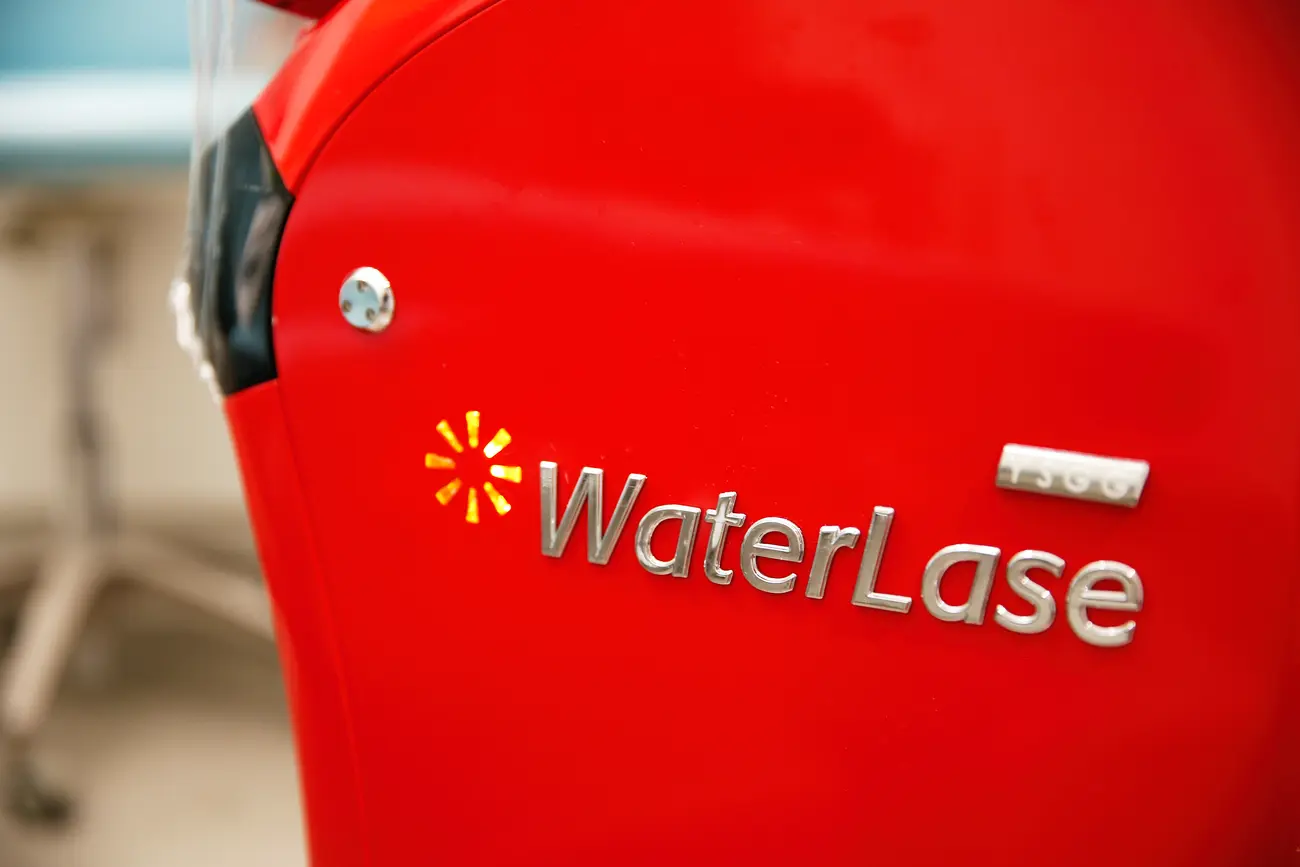
The WaterLase is an all-tissue laser rather than a single-purpose console. The same unit helps with access through an existing crown, removing a post during retreatment, disinfection, and soft-tissue work in root-end surgery. That is part of why it is in routine use here instead of reserved for selected cases, and why it is never an upcharge.
One honest caveat. Laser-assisted irrigation improves on proven chemical and mechanical disinfection; it does not replace it. The irrigating solution and the files still do the primary work. The evidence base is good and still developing, and we will tell you plainly where it is settled and where it is not.
See it in action
This short animation shows what the laser is doing inside the tooth: the energy pulse travelling through the irrigating solution, and the fluid movement it sets off down into the canal. It is the clearest way to see what is described above.